Parallels For Mac Dropbox
Knowledgebase; Parallels Desktop for Mac Standard Edition; Parallels Desktop for Mac Pro Edition; Parallels Desktop for Mac Business Edition; Parallels Desktop Lite.
In the classic 'which is better' argument between Macs and PC's, PC advocates sometimes bring up features or characteristics of the Windows operating system as an argument for PC's being better than Macs. These individuals overlook a key feature of the Mac lineup - you can run Windows on them. While you need to purchase a copy of the Windows operating system separately from your Mac, once you do you can install it and enjoy the benefits of both operating systems. This is especially useful for individuals who want to use Macs but may rely on a few programs that are Windows-specific.
Mac parallels free download - Parallels Desktop for Mac, Parallels Server for Mac, WinZip Mac, and many more programs. With direct support for Dropbox and Google Drive, powerful file. With Parallels Desktop, you can switch between Mac and Windows without ever needing to reboot your computer. If you have already installed Windows 10, Windows 8.1, Windows 8, or Windows 7 on your Mac using Boot Camp, you can set Parallels Desktop to run Windows from the Boot Camp Partition or import Windows and your data from Boot Camp into. Parallels Desktop 13.1.0 crack Key means that you can run Home windows and Mac purposes side by aspect. Pick out your see to generate Home windows invisible whilst even now applying its applications, or preserve the acquainted Home windows background and controls with your Mac.
If you are looking to install Windows on your Mac, you have two options. You can either install Windows in Boot Camp, a native feature of the Mac OS X operating system, or you can use a virtualization program. These are third-party applications that run on your Mac just like any other program. They create a virtualization of another computer, allowing you to install a separate operating system. With virtualization software, it is almost like you are using two computers at the same time on one machine. There are many virtualization programs available, but Parallels Desktop for Mac is the most popular and will be the one we focus on. If you'd like to check out other virtualization options, VMware, Citrix and Red Hat are good alternatives.
Depending on your specific needs, you may want to chose Boot Camp for your Windows install or you may want to buy a virtualization program. They both have their own specific advantages and disadvantages when you compare them. However, before you make the decision to purchase Windows and install it on your Mac, you'll want to double check that your Mac is compatible with the Windows version you are planning to run. Use this handy reference from Apple to determine which versions of Windows your Mac is compatible with.
Once you have the appropriate version of Windows, you now need to decide whether you would like to install it with Boot Camp or Parallels.
Mac Os Parallels
How It Works
Boot Camp is built into the OS X operating system of the Macs. If you go to your Applications > Utilities folder, you will see the Boot Camp Assistant app. Boot Camp makes a separate partition on your computer's hard drive (think of it as splitting your hard drive into two separate parts) specifically for installing and running windows. Upon launching the Boot Camp Assistant app, you have the option to change how large this partition is. Once Windows is installed in Boot Camp, every time you turn on your computer, you will be asked to select the operating system you would like to run. This means to switch from OS X to Windows, you need to reboot your Mac.

Advantages
- Built into the Mac OS X operating system
- Because Boot Camp runs Windows completely isolated from OS X instead of at the same time (like with virtualization), Boot Camp is less of a strain on your Mac's memory and is easier on your Mac to keep up and running.
- The Boot Camp Assistant app guides you through the install process
- Completely free! All you have to do is buy Windows and not any additional software
- Free and easy updates
Disadvantages
- Once you partition the hard drive, you cannot adjust the partition size. Meaning if you create a 200GB partition for Windows but run out of storage, you would need to completely reset Boot Camp and repartition to the size you desire.
- Every time you wish to switch between operating systems, you need to reboot your computer
- No easy way of transferring files and data between operating systems. Either email them to yourself, use a cloud service like Dropbox or iCloud Drive, or use an external device like a USB drive or CD.
- Because you need to partition the hard drive, you are effectively decreasing the available space on the OS X side of your Mac.
How It Works
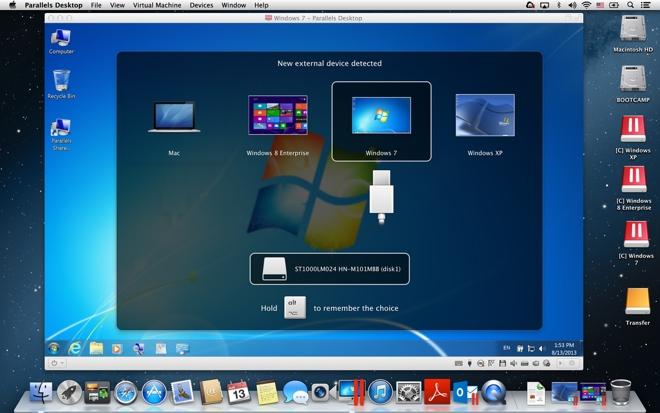
If you decide to use Parallels Desktop, you first need to purchase both the Parallels program and your Windows operating system. The current version of Parallels Desktop is Parallels 10. It is available here for $79.99. Once you purchase, download and install Parallels, you can open the program and install your Windows operating system within it. Much like Boot Camp, you decide how much space you want to allocate toward Windows, but unlike Boot Camp, you can easily change these storage options after installation. Parallels runs like any other app on your Mac. When it is up and running, you see an entire Windows desktop within a window on your Mac (you can obviously full screen the program as well). This makes switching back and forth between systems incredibly easy.
Advantages
- More functional than Boot Camp in the sense that you can run both operating systems at one time
- Easy file integration between systems. You can even link desktops between your Parallels program and OS X so that any documents created in one system are automatically copied and saved to the other system.
- Coherence Mode. This feature of Parallels blends the Windows and OS X environments together, giving you a common interface for both applications. This means that instead of having a whole Windows Desktop open within OS X, you can open Windows apps in Coherence Mode, and they look just as if you opened a Mac program.
- No need to create a separate partition on your hard drive for Windows that cannot be easily changed as with Boot Camp.
Disadvantages
- Compared to Boot Camp, Parallels is a greater strain on your Mac's memory and processing power since both operating systems are running at the same time. I would say that if you want to smoothly run either Windows 7, 8 or 10 on your Mac in Parallels, you should at least have 4GB of RAM on your Mac and if you like using many apps at the same time, I'd recommend having at least 8GB.
- Parallels is a more expensive option than Boot Camp since you have to buy the Parallels software.
- Updates are not as easy and affordable as Boot Camp. There is a new version of Parallels released in tandem with OS X updates every year and it usually costs $49.99 to upgrade. If you update the OS X version on your Mac, you will need the new Parallels version in order to be compatible. You do not need to reinstall Windows each time you update Parallels, however.
- Some people may find that the Parallels route has a steeper learning curve than Boot Camp as Parallels is a completely separate application with far more preferences and settings to learn (or be confused by), whereas Boot Camp is a more straightforward setup.
If you have an older computer with less than 4GB of RAM, you probably want to go with Boot Camp as you will notice decreased performance running Parallels. If you're someone who wants to keep their Windows and OS X experiences entirely separate, Boot Camp is also the best option for you. Those looking to install Windows on their Mac as affordably as possible will also want to go the Boot Camp route. If you want to run Windows and Mac apps together at the same time and be able to quickly switch back and forth between operating systems, you definitely want to go with Parallels or another virtualization software (they all do virtually the same thing, no pun intended). My personal recommendation is that if you have a computer with enough RAM and a processor to handle it, go with Parallels. I find it easier to use and the ability to run Windows apps in Coherence Mode is awesome - giving you the best of both operating system worlds.
Thanks for reading! If you have any questions about Boot Camp, Parallels, virtualization or anything else, leave us a comment below or hit us up on our web chat! If you need help installing Windows on your Mac, our Apple Technicians are able to help you out. We charge $95 for the install and can also help you with purchasing and downloading Parallels and the Windows operating system!
- Pros
Fast performance in testing. Tight integration with guest OSes. Effortless installation. Flexible file and folder tools. Options for opening Mac files in Windows apps. Can install macOS virtual machines directly from the Mac recovery partition.
- Cons
Some Mac-integration features can be confusing or impractical until you turn them off. Only runs on a Mac, so you can't share guest machines with Windows or Linux users.
- Bottom Line
Parallels Desktop is an excellent way to run Windows apps on MacOS, especially for ordinary users. It's fast in testing, offers tight integration between Macs and guest systems, and supports many other OSes, too.
Parallels Desktop is the fastest and friendliest way to run Windows apps on a Mac for the majority of users who are likely to want to do so. IT pros may prefer VMware Fusion; expert users who want no-cost apps will prefer the open-source VirtualBox. Hardcore gamers may prefer Apple's Boot Camp, which lets users boot directly into Windows, with the added bonus of native graphics card support. For most ordinary Mac users who prefer Windows versions of apps like Microsoft Office or AutoCAD, however, or who use Windows-only apps like CorelDraw or WordPerfect Office, Parallels Desktop is the clear first choice for virtualization software.
- $79.99
- $0.00
- $0.00
- $39.99
- $0.00
- $139.99
Platforms and Pricing
Parallels Desktop supports all Windows versions since Windows 2000, all Intel-based macOS versions (with some exceptions for licensing reasons), many flavors of Linux, BSD, Solaris, and a few other OSes. VMware Fusion and VirtualBox are even more flexible, and can run historical curiosities like OS/2 and NeXTSTEP. Also, unlike Parallels Desktop, VMware Fusion and VirtualBox have versions that run on Windows and Linux machines, while Parallels Desktop is Mac-only.
There's one other important difference: Parallels Desktop is a subscription-only product, so you'll have to pay $79.99 per year for the home-and-student version or $99.99 for the Pro Edition. VMware Fusion has a one-time cost (a model some consumers may prefer) of $79.99 for its standard version and $159.99 for its Pro version. VirtualBox is free for personal use and $50 for corporate use, but you get far fewer convenience features out of the box with this open-source product.
Get Started With Parallels
Parallels starts up with a menu for creating a new virtual machine or opening an existing one. This is where Parallels' focus on ordinary end users shines best. Unlike all other virtualization apps, Parallels doesn't expect you to have a Windows or Linux installer disk or disk image ready when you start it up, although it can use that image if you have one. Instead, Parallel's user-helpful menu lets you buy a Windows 10 download directly from Microsoft, or simply download a Windows 10 installer if you already have a license key.
Another set of options lets you install a Parallels system-export utility on your Windows PC, and export it to Parallels via a network (slowly) or an external drive. A scrolling list at the foot of the menu lets you download specific versions of Linux or Android, install a virtual copy of macOS from your Mac's hidden recovery partition, or install Windows from a Boot Camp partition if you have one.
Like VMware and VirtualBox, Parallels supports a Snapshot feature that lets you save a guest system in one or more configurations that you know works well, and then restore a saved configuration after making changes in the system that you don't want to preserve. However, Parallels is unique in supplementing this feature with a Rollback option that automatically discards all changes to a system when you shut it down, so it works like a kiosk system, returning to its pristine condition every time you power it up. This feature can be invaluable in testing, or in environments like schools where users are liable to leave systems a lot messier than they found them. If you used Microsoft's long-abandoned VirtualPC app, you'll remember this feature, and will welcome its return in Parallels.
Parallel's Performance
Compared to VMware, Parallels starts up Windows at top speed in testing. On my vintage 2015 MacBook Pro, Parallels boots Windows 10 to the desktop in 35 seconds, compared to 60 seconds for VMware. VirtualBox matches Parallels' boot speed, but it performs far fewer integration tasks while booting up. For example, VirtualBox doesn't provide printer integration and the ability to open Windows files with Mac apps and vice versa.
One reason for Parallels' bootup speed advantage is that Parallels uses an emulated PC BIOS that supports the Fast Startup option, and the others don't. The speed difference isn't nearly as obvious when running Windows apps after the OS starts up, however. Parallels feels slightly faster than its rivals, but not drastically so. Fast as it is, Parallels won't satisfy hard-core gamers because Parallels, like VMware Fusion, only supports DirectX 10, while VirtualBox only supports DirectX 9. There's nothing that Parallels can do about this limitation, which is the result of the Mac's limited support for OpenGL (Open Graphics Library) features.
By default when Parallels runs a Windows system, any files on your Mac desktop will also appear on your Windows desktop. This may sound convenient, but it's a feature that I always to turn off in Parallels' settings dialog. One reason I turn it off is that it leaves the Windows desktop cluttered. Another is that much of what I keep on my Mac desktop—like folders and apps—simply won't work when I click on them in Parallels' Windows desktop. Parallels tends to go overboard with integration features, turning them on by default whether you want them or not.
Another way Parallels goes overboard with its integration is its tendency to clutter up its dialogs and your Mac system with icons and folders that you probably don't want. For example, by default, it adds a folder full of Windows application to your Mac's dock, and a Parallels menu to Mac's menu bar—though you can turn these off by poking around the options and preferences windows. Some of Parallels' menus include links to a set of Mac-related utilities called the Parallels Toolbox; some of these utilities, like a quick disk-cleaning menu, are convenient, but you probably don't want all of them, and they have nothing to do with virtualization. Another link on Parallels' menus invites you to buy Acronis True Image backup software, which you probably don't need if you use your Mac's built-in backup features.
Parallel Computing
Anyone who wants to run a Windows app on the Mac should choose between our two Editors' Choice apps, Parallels Desktop and VMware Fusion. For IT managers, developers, and for many tech-savvy users, VMware is the best choice. For most home, school, and SOHO users who don't need VMware's unique cross-platform support and legacy features, Parallels Desktop is the fastest, most hassle-free way to run Windows apps on a Mac.
Parallels Desktop (for Mac)
Bottom Line: Parallels Desktop is an excellent way to run Windows apps on MacOS, especially for ordinary users. It's fast in testing, offers tight integration between Macs and guest systems, and supports many other OSes, too.
Other Parallels Software International System & Performance
- $79.99
- $79.99
- $49.99