Parallels For Mac Force
 Launch Parallels Desktop.app, but do not start your virtual machine. Click on the Parallels icon on the Mac menu bar > select Control Center. Right-click on your virtual machine and select Remove. The virtual machine (VM) files in Parallels Desktop® for Mac can be quite large—I have several that are over 100 GB. So if you’re not using a VM anymore (or just rarely use it), you can get back a lot of space on your Mac® by deleting it, or at least moving it to an external drive.
I have a macbook pro. Recently I installed parallels desktop on it. But the problem i have is when I connect a usb device to my macbook it is not being detected in the windows parallel desktop. Also I have no idea how to get right click options in the parallel windows desktop. Can you please help me. Thank you for your help in advance.
I have to admit that I was stymied for a long time about how to right-click within Parallels, a great virtualization application available for Mac OS X that lets you run Microsoft Windows XP, Windows Vista, Linux and a variety of other operating systems within Mac OS X. Plug in an external two-button mouse, of course, and the right click just works, but within Parallels?
The secret is to hold down the Control-Shift buttons when you click on the mouse within Parallels. I found that out by actually reading their documentation (imagine!) after puzzling through the problem for far too many hours. Your Control key might well be labeled “Ctrl” on your MacBook Pro, as it is with mine, of course.
The USB device question is straightforward too. In the Preferences for Parallels you can specify whether you want USB devices to be auto-connected upon detection or not. Sounds like you have this option turned off. To change it, you need to shut down your virtual machine, if it’s running, and then choose Edit –> Virtual Machine…, within which you’ll find one of the options is:
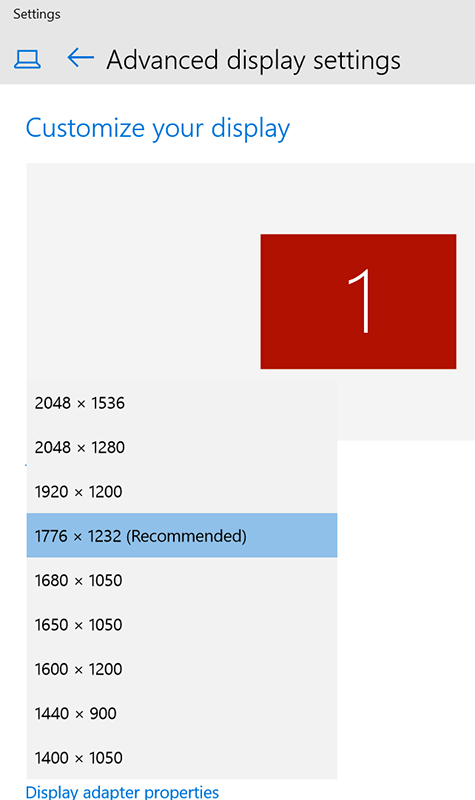
On mine you can see that I have my Connection Options set to “Connect to Guest OS”: yours is set to “Connect to Mac OS” instead. A good third alternative, by the way, is to simply choose the option “Ask me what to do”, which means that every time it detects a new USB device, you’ll have the option of letting Parallels have it or let Mac OS X have it.
Finally, if you are running Parallels and you find that your USB devices are being captured by Mac OS X but not your virtual guest OS, you can also go to the Devices menu, find the peripheral in question, and choose it to have Parallels wrest control from Mac OS X and hand it to your guest operating system. If the peripheral is checked, Parallels owns it, and if it’s not checked, the Mac operating system owns it:
As you can see, Parallels has stolen control of my Apple iPhone from the Mac operating system and the Mac side can’t see it. Interestingly, when hooked up this way, the phone doesn’t appear to charge from the USB connection, but when I release it from Parallels (by simply selecting it in this Devices menu) it syncs up with iTunes on my Mac and charges from the USB cable too.
That should get you going a bit more efficiently with Parallels. Enjoy!
Let’s Stay In Touch!
Today, Parallels launched Parallels Desktop 11 for the Mac.Windows users on Apple hardware were given a taste of Windows 10 during the Windows Insider Preview with an update to Parallels 10. These tools add extra virtual drivers that make your virtual Mac run better, and Parallels Tools actually works with macOS Mojave as of this writing. Click Actions > Install Parallels Tools in the menu bar of your host machine, and the installer will launch inside your virtual machine. Parallels solutions enable seamless delivery of virtual desktops and applications to any device, running Windows on a Mac, Mac management with Microsoft SCCM, and remote access to PC and Mac computers from any device.
I bought the base 2012 Mac Mini last week and I need to use parallels for Sony Vegas and capture software via Xbox/PS3. It keeps lagging constantly. I am looking to return the Mac Mini and upgrade to a different desktop option. Parallels Desktop for Mac is a hardware emulation virtualization software, using hypervisor technology that works by mapping the host computer’s hardware resources directly to the virtual machine’s resources. Parallels for MAC free. Parallels for mac reviews 2018. download full version is an amazing that deals with simple user interface and easy to use. It relieved the advanced form after this brief timeframe and furthermore, that is new to work area virtualization pc programming for Mac PCs.